Huge Price Reduction-''Southern Living''

Huge Price Reduction-''Southern Living''

Entrance to Walterboro's Great Swamp
If you’re looking to buy a home, you probably want to secure the lowest interest rate possible for your home loan. Over the last couple of years, that was easier to do as the housing market saw record-low mortgage rates, but this year rates have risen dramatically.
If you’re looking for ways to combat today’s higher rates and lock in the lowest one you can, here are a few factors to focus on. Since approval opportunities can vary, connect with a trusted lender for customized advice.
Credit scores can play a big role in your mortgage rate. Freddie Mac explains:
“When you build and maintain strong credit, mortgage lenders have greater confidence when qualifying you for a mortgage because they see that you’ve paid back your loans as agreed and used your credit wisely. Strong credit also means your lender is more apt to approve you for a mortgage that has more favorable terms and a lower interest rate.”
That’s why it’s important to maintain a good credit score. If you want to focus on improving your score, your trusted advisor can give you expert advice to help.
There are many types of loans, each offering different terms for qualified buyers. The Consumer Financial Protection Bureau (CFPB) says:
“There are several broad categories of mortgage loans, such as conventional, FHA, USDA, and VA loans. Lenders decide which products to offer, and loan types have different eligibility requirements. Rates can be significantly different depending on what loan type you choose.”
When working with your real estate advisor, make sure you find out what’s available in your area and which types of loans you may qualify for.
Another factor to consider is the term of your loan. Just like with location and loan types, you have options. Freddie Mac says:
“When choosing the right home loan for you, it’s important to consider the loan term, which is the length of time it will take you to repay your loan before you fully own your home. Your loan term will affect your interest rate, monthly payment, and the total amount of interest you will pay over the life of the loan.”
Depending on your situation, the length of your loan can also change your mortgage rate.
If you’re a current homeowner looking to sell and make a move, you can use the home equity you’ve built over time toward the down payment on your next home. The CFPB explains:
“In general, a larger down payment means a lower interest rate, because lenders see a lower level of risk when you have more stake in the property. So if you can comfortably put 20 percent or more down, do it—you’ll usually get a lower interest rate.”
To learn more, connect with a lender to find out the difference a higher down payment can make for your new mortgage.
These are just few factors that can help determine your mortgage rate if you’re buying a home. The best thing you can do is have a team of professionals on your side. Connect with a local real estate professional and a trusted lender so you have the expert advice you need in each step of the process.
Walterboro, SC Homes for Sale Realtor

A recent article from realtor.com:
“This fall, a more moderate pace of home selling, more listings to choose from, and softening price growth will provide some breathing room for buyers searching for a home during what is typically the best time to buy a home.”
Michael Lane, VP and General Manager, ShowingTime:
“Buyers will continue to see less competition for homes and have more time to tour homes they like and consider their options.”
Selma Hepp, Interim Lead of the Office of the Chief Economist, CoreLogic:
“. . . record equity continues to provide fuel for housing demand, particularly if households are relocating to more affordable areas.”
Danielle Hale, Chief Economist, realtor.com:
“For homeowners deciding whether to make a move this year, remember that listing prices – while lower than a few months ago – remain higher than in prior years, so you’re still likely to find opportunities to cash-in on record-high levels of equity, particularly if you’ve owned your home for a longer period of time.”
Mortgage rates, home prices, and the supply of homes for sale are top of mind for buyers and sellers today. And if you want the latest information for Walterboro or the surrounding area, give us a call and will be happy to share the local data. Call me today! 843-547-5845

As you set out to buy a home, saving for a down payment is likely top of mind. But you may still have questions about the process, including how much to save and where to start.
If that sounds like you, your down payment could be more in reach than you originally thought. Here’s why.
If you believe you have to put 20% down on a home, you may have based your goal on a common misconception. Freddie Mac explains:
“. . . nearly a third of prospective homebuyers think they need a down payment of 20% or more to buy a home. This myth remains one of the largest perceived barriers to achieving homeownership.”
Unless it’s specified by your loan type or lender, it’s typically not required to put 20% down. According to the latest Profile of Home Buyers and Sellers from the National Association of Realtors (NAR), the median down payment hasn’t been over 20% since 2005. There are even loan types, like FHA loans, with down payments as low as 3.5%, as well as options like VA loans and USDA loans with no down payment requirements for qualified applicants.
This is good news for you because it means you could be closer to your homebuying dream than you realize. For more information, turn to a trusted lender.
A professional will be able to show you other options that could help you get closer to your down payment goal. According to latest Homeownership Program Index from downpaymentresource.com, there are over 2,000 homebuyer assistance programs in the U.S., and the majority are intended to help with down payments.
A recent article explains why programs like these are helpful:
“These resources can immediately build your home buying power and help you take action sooner than you thought possible.”
And if you’re wondering if you have to be a first-time buyer to qualify for these programs, that’s not always the case. According to an article from downpaymentresource.com:
“It is a common misconception that homebuyer assistance is only available to first-time homebuyers, however, 38% of homebuyer assistance programs in Q1 2022 did not have a first-time homebuyer requirement.”
There are also location and profession-based programs you could qualify for as well.
Saving for your down payment is an important first step on your homebuying journey. Connect with a local real estate advisor and trusted lender today to begin exploring your options.
Walterboro, SC Homes for Sale in Walterboro, SC Realtor

Rising interest rates have begun to slow an overheated housing market as monthly mortgage payments have risen dramatically since the beginning of the year. This is leaving some people who want to purchase a home priced out of the market and others wondering if now is the time to buy one. But this rise in borrowing cost shows no signs of letting up soon.
Economic uncertainty and the volatility of the financial markets are causing mortgage rates to rise. George Ratiu, Senior Economist and Manager of Economic Research at realtor.com, says this:
“While even two months ago rates above 7% may have seemed unthinkable, at the current pace, we can expect rates to surpass that level in the next three months.”
So, is now the right time to buy a home? Anyone thinking about buying a home today should ask themselves two questions:
There are two places to turn to answer this question. First is the consensus of what experts are saying. If you look at what experts are projecting for home prices in 2023, they’re forecasting home price appreciation around 2%. While it’s true some are calling for depreciation, most are calling for appreciation in home values over the next year.
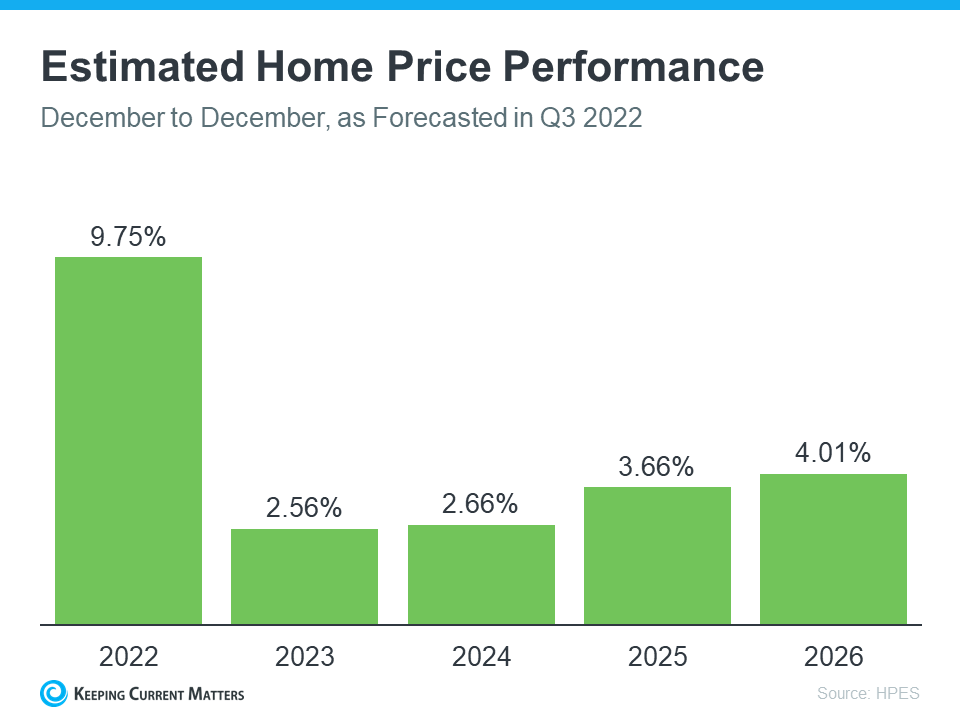
The second spot to turn to for information is the Home Price Expectation Survey from Pulsenomics – a survey of a national panel of over one hundred economists, real estate experts, and investment and market strategists. According to the latest release, the experts surveyed are also calling for home price appreciation for the next several years (see graph below):
Like mentioned above, Ratiu sees mortgage rates rising over the next several months. Another expert agrees. Mark Fleming, Chief Economist at First American, says:
“While mortgage rates are expected to continue to drift higher over the coming months, much of the rapid increase in rates is likely behind us.”
The instability in the world and higher inflation are driving this volatile market, resulting in higher borrowing rates for those looking to buy homes.
If you’re thinking about buying a home, asking yourself about home prices and mortgage rates will help you make a powerful and confident decision. Experts see both prices and rates rising in the future. The alternative is to rent, but rents are also increasing. That may mean buying a home makes more sense than renting.

Today’s cooling housing market, the rise in mortgage rates, and mounting economic concerns have some people questioning: should I still buy a home this year? While it’s true this year has unique challenges for homebuyers, it’s important to factor the long-term benefits of homeownership into your decision.
Consider this: if you know people who bought a home 5, 10, or even 30 years ago, you’re probably going to have a hard time finding someone who regrets their decision. Why is that? The reason is tied to how you gain equity and wealth as home values grow with time.
The National Association of Realtors (NAR) explains:
“Home equity gains are built up through price appreciation and by paying off the mortgage through principal payments.”
Here’s a look at how just the home price appreciation piece can really add up over the years.
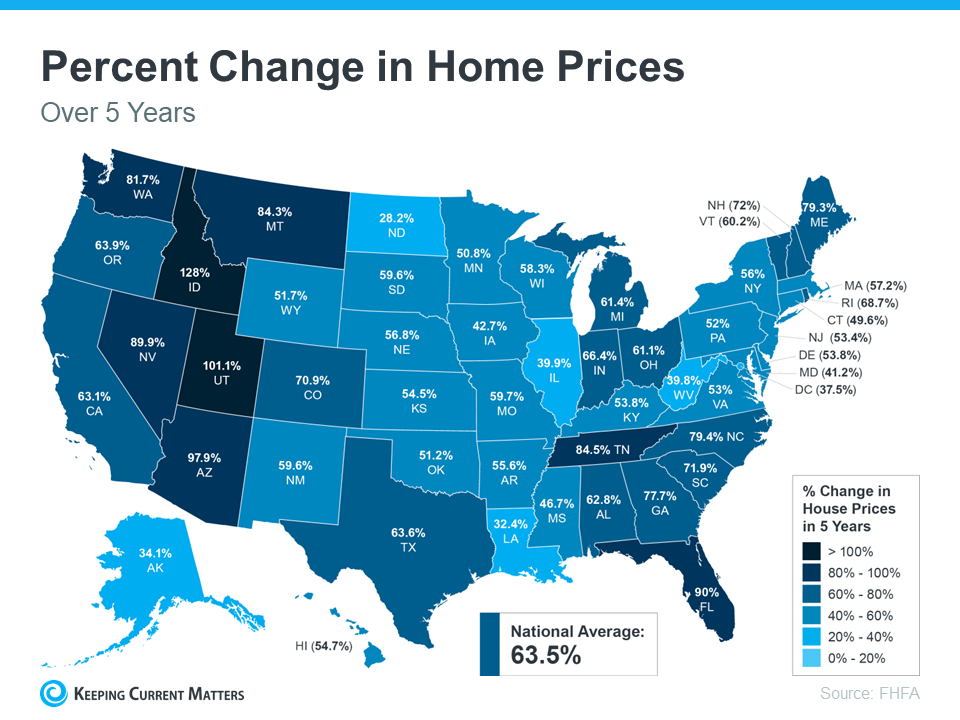
Even though home price appreciation has moderated this year, home values have still increased significantly in recent years. The map below uses data from the Federal Housing Finance Agency (FHFA) to show just how noteworthy those gains have been over the last five years.
If you look at the percent change in home prices, you can see home prices grew on average by almost 64% nationwide over that period.
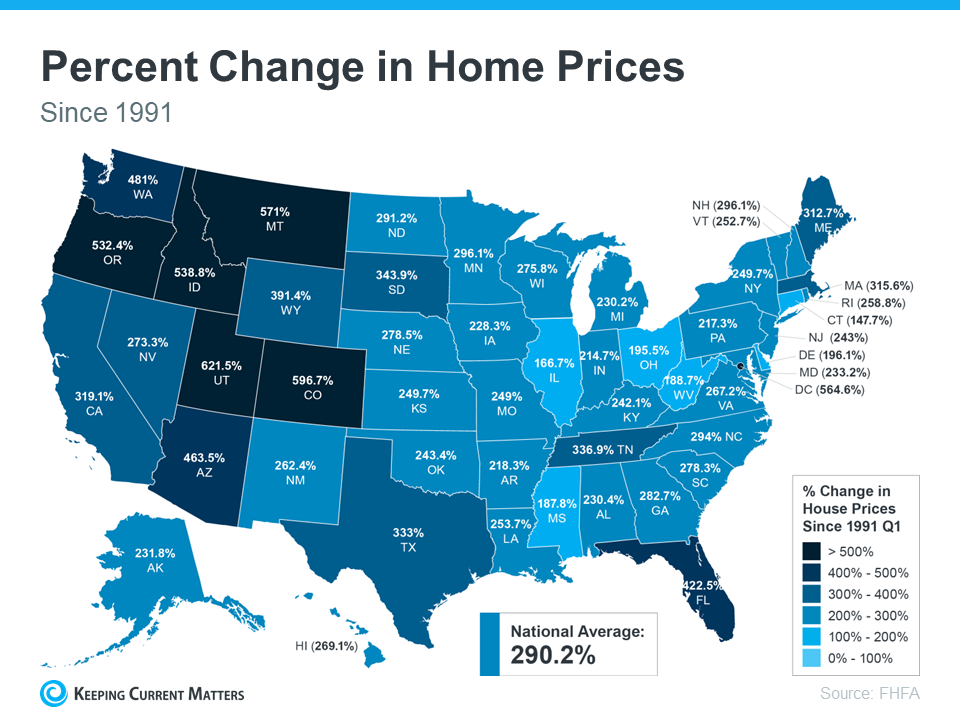
That means a home’s value can increase substantially in a short time. And if you expand that time frame even more, the benefit of homeownership and the drastic gains you stand to make become even clearer (see map below):
The second map shows, nationwide, home prices appreciated by an average of over 290% over roughly a thirty-year span.
While home price growth varies by state and local area, the nationwide average tells you the typical homeowner who bought a house thirty years ago saw their home almost triple in value over that time. This is why homeowners who bought their homes years ago are still happy with their decision.
Even if home price appreciation eases as the market cools this year, experts say home prices are still expected to appreciate nationally in 2023. That means, in most markets, your home should grow in value over the next year even if the pace is slower than it was during the peak market frenzy when prices skyrocketed.
The alternative to buying a home is renting, and rental prices have been climbing for decades. So why rent and fight annual lease hikes for no long-term financial benefit? Instead, consider buying a home. It’s an investment in your future that could set you up for long-term gains.
Don’t let the shifting market delay your dreams. Data shows home values typically appreciate over time, and that gives your net worth a nice boost. If you’re ready to start your journey to homeownership, reach out to a real estate professional today.


The average home price is down 2% ($8,800) from its June peak nationally
Home prices are now posting the biggest monthly declines since January 2009,
according to the latest Mortgage Monitor report from Black Knight.
Median home prices in August fell 0.98%, only slightly better than July’s 1.05% monthly
decline. The average home price is down 2% ($8,800) from its June peak nationally as
we enter the historically slower fall-winter homebuying season.
The housing market has not seen such a significant two-month drop in prices since shortly
after the collapse of Lehman Brothers in winter of 2008, Black Knight said on Monday.
Skyrocketing mortgage rates – now in the 7% range for some buyers – and limited inventory
have driven mortgage affordability to its lowest levels since the early 1980s, a reversal from
the frenetic boom in buying during 2020 and 2021.
With mortgage rates at 6.7% as of Sept. 29, it takes 38.2% of the median household income
to make the monthly mortgage payment on the median-priced home bought with a 30-year
mortgage and 20% down, Black Knight said. That monthly payment is up $930 from August
2021, a 73% increase.
“Historically low inventory – along with record low interest rates – was one of the key drivers
behind U.S. home prices seeing essentially a decade’s worth of appreciation in just two-
and-a-half years,” added Ben Graboske, Black Knight’s president of Black Knight data & analytics.
Home prices are beginning to fall from post-pandemic peaks but remain up 12.1% from Aug.
2021 due to the record growth seen in late 2021 and early 2022, Black Knight said in its report.
Annual home price growth rates are poised to continue falling in coming months, though it’s
unclear where the bottom is.
Much of that depends on how much inventory returns to the market. After seeing an uptick
in listings from May through July, inventory levels stalled in August, growing at just 1/10th
the rate of recent months. The market grew from just 1.7 months of for-sale inventory to 3.1
months before dropping down to three months in August.
“Right now, prospective sellers are not only coming to grips with falling demand and declining
prices due to sharply higher interest rates, but they also have a growing disincentive to give up
their own historically low-rate mortgages in this environment,” said Graboske. “Some may be
waiting out the market to see if demand – and prices – return in the spring.”
While 20% of markets have seen only marginal declines (less than 1%) so far, a third have
experienced drops of 3% or more – including nine where prices have fallen more than 5%,
Black Knight researchers found. The sharpest correction was in San Jose (-13%, or, about $203,000),
followed by San Francisco (-10.8%, or roughly $137,000) and Seattle (-9.9%, or about $83,000),
but other formerly scorching-hot markets have also cooled majorly since June. Las Vegas, Austin,
Minneapolis, Washington, D.C., Raleigh and Nashville have all shed 3% of home value in recent months.

The real estate market is on just about everyone’s mind these days. That’s because the unsustainable market of the past two years is behind us, and the difference is being felt. The question now is, just how financially strong are homeowners throughout the country? Mortgage debt grew beyond 10 trillion dollars over the past year, and many called that a troubling sign when it happened for the first time in history.
Recently Odeta Kushi, Deputy Chief Economist at First American, answered that question when she said:
“U.S. households own $41 trillion in owner-occupied real estate, just over $12 trillion in debt, and the remaining ~$29 trillion in equity. The national “LTV” in Q2 2022 was 29.5%, the lowest since 1983.”
She continued on to say:
“Homeowners had an average of $320,000 in inflation-adjusted equity in their homes in Q2 2022, an all-time high.”
The term LTV refers to loan to value ratio. For more context, here’s how the Mortgage Reports defines it:
“Your ‘loan to value ratio’ (LTV) compares the size of your mortgage loan to the value of the home. For example: If your home is worth $200,000, and you have a mortgage for $180,000, your LTV ratio is 90% — because the loan makes up 90% of the total price.
You can also think about LTV in terms of your down payment. If you put 20% down, that means you’re borrowing 80% of the home’s value. So your LTV ratio is 80%.”
Why Is This Important?
This is yet another reason we won’t see the housing market crash. Home equity allows homeowners to be in control. For example, if someone did need to sell their home, they likely have the equity they need to be able to sell it and still put money in their pocket. This was not the case back in 2008, when many owed more on their homes than they were worth.
Homeowners today have more financial strength than they have had since 1983. This is a combination of how homeowners have handled equity since the crash and rising home prices of the last two years. And this is yet another reason homeownership in any market makes sense.